


“Geniuses aren’t necessarily nice people.” That’s what Rab Hatfield told me when I asked how Michelangelo—the artist, not the ninja turtle—acquired his wealth. I was just beginning to work on the book Real Artists Don’t Starve and was chatting with the retired art history professor as part of my research.
That was the first thing he said to me, the bit about geniuses not being nice. He then went on to tell me the whole story: how the master wasn’t born wealthy but went on to amass a fortune worth nearly $50 million.
Michelangelo came from a working class family. His father came from a line of failed bankers and worked briefly for the government. They were, by no measure, people “of means.” But they did have one advantage: a last name.
We tend to forget that surnames are a relatively modern invention and for much of human history, people didn’t have them. Jesus’s last name wasn’t Christ, and Leonardo was from Vinci, a commune in Tuscany.
Last names were a sign of nobility. They meant you had money and some land, that you deserved respect. And for whatever reason (it’s still something of a mystery), Michelangelo had one.
The legend was that the Buonarroti family descended from some countess from generations before and had since fallen on hard times. There is no evidence for this, but the young artist grew up hearing the story, and believed it with all his heart. Which just goes to show you: it’s not whether a story is true that matters but how much you believe it.
So when his older brother entered the priesthood, it fell on the second-born son to carry the family torch, and return the Buonarroti name to its former glory. Michelangelo’s decision to become an artist did not help this quest. At the time, artists were merchants who kept shops and sold work directly to their clients. They were not wealthy. If he was going to do his duty and pursue art as a vocation, Michelangelo was going to have to become a new kind of artist.
Starting out Stubborn
As a teenager, the young artist sought to study under the painter Domenico Ghirlandaio. Instead of paying the master for his education, though, he demanded a salary. This was unheard of. Apprentices paid to be apprenticed. They did not receive payment.
In the guild system, taking on an apprentice required a lot of resources—time, patience, money to house and feed young students—so most apprentices’ parents made a financial contribution to help relieve the burden.
But by all accounts, Michelangelo did the opposite. Believing he had come from noble stock, he essentially demanded special treatment. And whether Ghirlandaio recognized the surname or was simply impressed by the boy’s impudence, he indulged him.
And, well, what would you do? If you had a whole studio of apprentices learning from you, all of whom were paying you, and one student you were paying—where would your attention go? Soon, it was clear that Ghirlandaio had a favorite, and it was Michelangelo.
Building a Network
In the same way that going to an Ivy League school in the twentieth century helped stack the deck in a person’s favor, getting apprenticed by the right teacher in the Renaissance could determine how well an artist fared in sixteenth-century Florence.
Michelangelo first studied under Ghirlandaio but was then soon introduced to Lorenzo de Medici, the “prince” of Florence who was looking for an exceptional apprentice to live in the palace and learn from Bertoldo di Giovanni, a sculptor who had studied under the master Donatello.
Ghirlandaio, of course, recommended his star student.
At this point, the artist was becoming a young man. He was living with one of the richest men in all of Europe, each day being trained by a renowned artist and exposed to the “who’s who” of the times.
Among those he regularly encountered were future queens, popes, and public intellectuals, many of whom would become patrons. It’s no exaggeration to say by the time Michelangelo received his first commission, he had already acquired an extensive rolodex of contacts.
And just as is the case now, who you knew mattered even then. Whether it was intentional or not, Michelangelo began to know the “right” people, building a network that would pay dividends in the future.
This made his career something extraordinary. Instead of working as a typical merchant, he almost immediately skipped the line. Soon, his clientele would include some of the most elite members of society, all of whom expected to pay top dollar.
Leveling Up
Ironically, it was his flexibility, not his stubbornness that led to some of Michelangelo’s most famous works. Though he started out a sculptor, he soon was “forced” to step into other forms.
All Renaissance artists were educated in drafting, painting, and sculpture; but he believed this last area was the finest art. In fact, he once got into a dispute with his elder Leonardo da Vinci over which was the higher form, and this argument resulted in a public painting contest to settle the dispute.
Michelangelo lost the contest, but the world now knew him as a skilled painter.
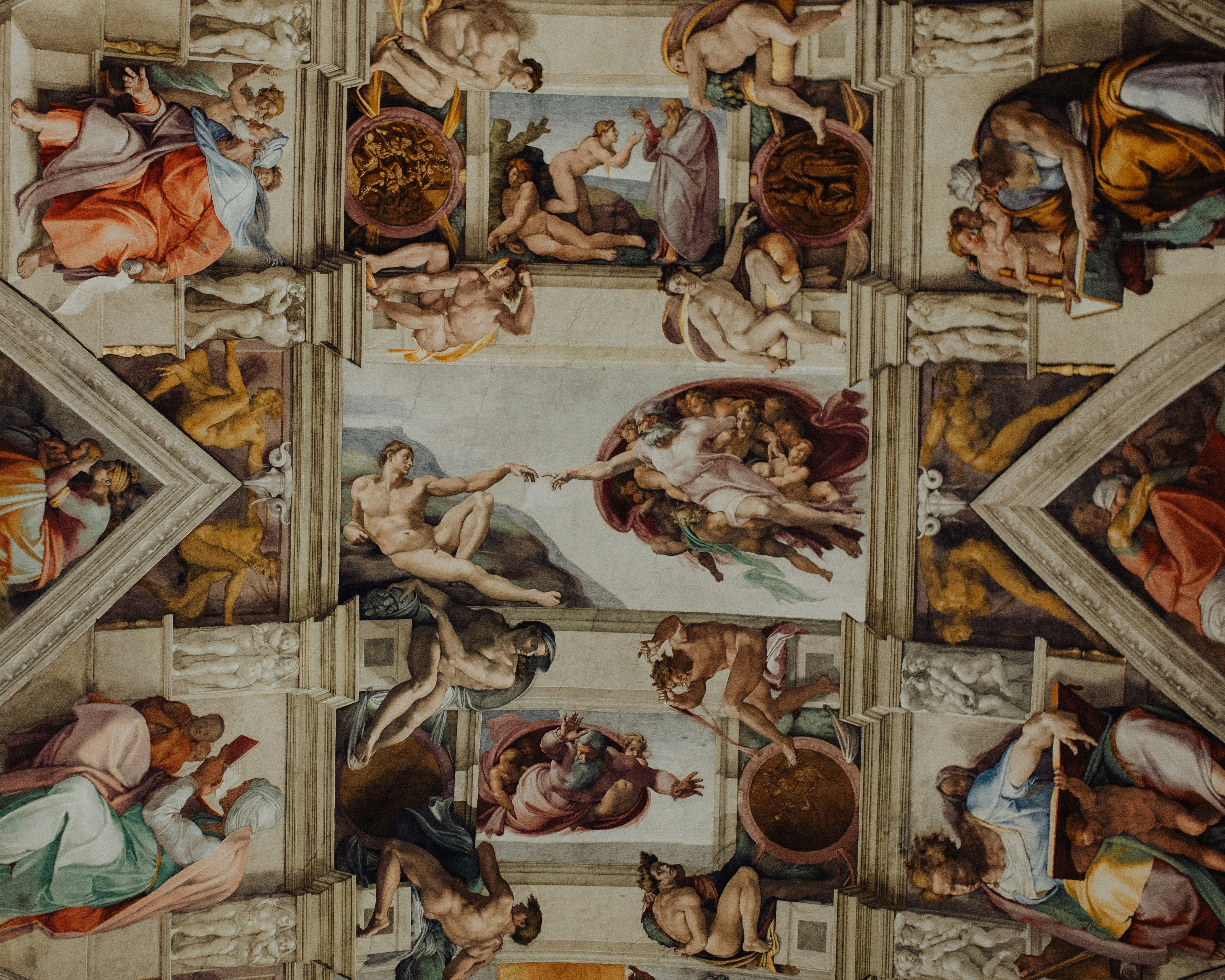
It was not long before the pope summoned him to paint the Sistine Chapel, a commission he initially resisted. But you can only resist a pope so much, and soon he was on his back, staring up at what would become the most famous ceiling in the world.
This led to other pivots, including a move into architecture, which included a design of the dome at St. Peter’s Basilica in the Vatican and a redesign of the basilica itself. One of his longest-running projects was the design and oversight of the Laurentian Library in Florence, which took over forty years to complete.
Towards the end of this major project, he had hundreds of employees and workers under him, making him the equivalent of a modern-day CEO and construction foreman. He seemed to have a knack for biting off more than he could chew, and then somehow learning how to chew it.
Counting the Cost
The man was savvy with money, investing much of it into property in his lifetime—the main signal of wealth in the Renaissance. He also enjoyed nice clothes.
Beyond that, Michelangelo was something of a miser, an Ebenezer Scrooge with a paint brush.
At one point, he purchased what became the family villa, sharing the land with his brothers and father, who lived there and helped him manage his finances. When they were unable to pay some of their debts back to him and failed to manage the money according to his standards, he seized the land and forced them out. By the end of his life, he had a complicated relationship with many of his loved ones.
It’s hard to say if this was a case of family members leeching off a rich relative, or if he turned on those who helped him get where he wanted to go. I have personally met plenty of successful people in my life, most of whom have similar stories: a radical belief in themselves, a willingness to do what needs to be done, and some resentment for helping others and not feeling appreciated.
In America, we’re taught that if we work hard and pursue our goals, we’ll eventually get everything we want and be happy. That last part is more whispered than spoken, but it is largely understood.
Yes, it seems clear that if you set your mind on a target and don’t stop, you’ll achieve that thing or something close to it. But once you get it, you will eventually want other things. And then, when will you stop? If there is always another carrot to dangle, when does a person get to be happy?
It’s an old story, of course, much older than Michelangelo, and one I can relate to. What do I gain if I get everything I want but lose the most crucial parts of myself? “I know plenty of successful people who are happy,” a friend once told me, “but their happiness has nothing to do with their success.”
I don’t know how Michelangelo felt about his wealth, or if that even matters now. Perhaps success is something like art itself, a compulsion that drives us to do things that defy reason, that we don’t even understand when we’re doing them. Maybe we’re all fools in that way, hopelessly chasing that which will never satisfy, and it’s the pursuit, not the acquisition, that makes it all worth it.
Then again, you have to wonder.
“So now, from this mad passion
Which made me take art for an idol and a king
I have learnt the burden of error that it bore
And what misfortune springs from man’s desire . . .
The world’s frivolities have robbed me of the time
That I was given for reflecting upon God.”
―Michelangelo Buonarroti
P.S. How do you wrestle with the question of happiness versus success? How do you deal with ambition versus contentment?
I confess to it still being a struggle for me at times. I’d love to hear your thoughts:
Note: Next month, I’m speaking at a conference in Kansas City, sharing more of these insights on art and money. If you’re in the area or are planning on making it to the event, come say hi. I’d love to meet you.
And be sure to pick up the book that inspired this post, if you don’t have it yet.
Love the story! I think at the end of the day, it's how we define success, and its relationship to happiness. We've all been programmed to think that money, achievement, and climbing the social ladder are what will make us happy. But I think most of us can now agree that it's not. Though I won't disregard their contribution to the formula.
However, I do think pursuing an authentic, mission-driven life and inner peace is the key to lifelong satisfaction. However, it's become popular to manufacture a purpose which defeats the whole point of authentic happiness.
The Michelangelo quote is spot on. I became a Christian at age 17 when I was watching a Billy Graham crusade and a guy said he lacked peace and purpose in his life, but after receiving Jesus he had both. I saw no purpose in the life before me and took his cue and did the same. I have lived a life since knowing that the only thing that would satisfy me is knowing God. (By the way, wasn’t it George Costanza who said “it’s not a lie if you believe it”?)